BRAKE RENDERING TEST IN QATAR
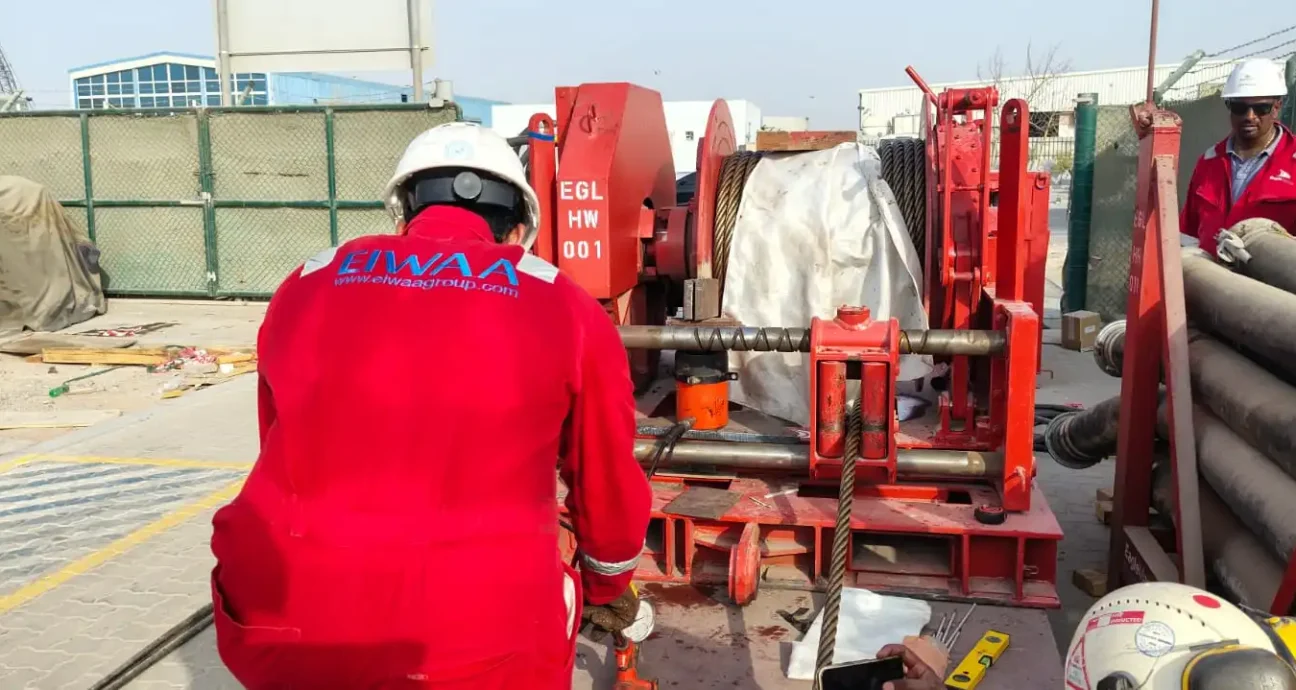
Annually, mooring winches on boats and ships are examined and tested to make sure there is no slippage or overload. Brake rendering, pull, and holding tests fall under this category. To ensure that the mooring lines and equipment are not being overloaded by the brake rendering and its capacity or slipping during any kind of loading at SWL or proof load, mooring winches must be checked on a regular basis and annually. The criteria for controlled testing, non-destructive evaluation services, safety assurance, and conformity with IMO and LEEA standards were all confirmed by our mooring winch brake rendering testing kit. Using hydraulic jacks, a calibrated dynamometer load cell, and lifting inspection tools, the IACS-approved load testing engineers examine the mooring winch’s proof load and brake holding capacity.
The following rules and standards apply to brake rendering testing and mooring winch inspection:
- Mooring equipment must be tested for safe lifting operation in compliance with SOLAS (Safety of Life at Sea) regulations Chapter II-1: Machinery and Electrical Installations.
- MSC.1/Circ.1175: Onboard Mooring and Towing Equipment Guidelines.
- MSC.1/Circ.1619, 2019: Marine classification standards for ship design mooring arrangements, specifications, and methods for the appropriate mooring fittings and equipment.
- MSC.1/Circ.1620, 2019: Mooring Line Regulations, Requirements, Procedures, and Classification for Inspection and Testing of Mooring Equipment.
- ISO 3730:2012: Mooring winch tests, protocols, and standards.
- ISO 1704:2007: Shipboard steel wire rope MBL and SWL requirements.
ANCHOR WINDLASS INSPECTION IN QATAR
For the maritime industry to operate safely and to comply with class norms, anchor windlass testing and inspection are crucial. Our class surveyors conduct pull testing, functional testing, NDT inspection, and visual examination of anchor windlasses using calibrated dynamometer load cells, shackles, and slings. By using eddy current testing, magnetic particle inspection, and dye penetrant examination, NDT inspection may confirm cracks and linear indication by overloading. The following codes and standards are followed by anchor windlass inspection and certification services:
- Anchoring and windlass marine equipment must be safe, secure, and subject to regular maintenance in compliance with SOLAS Chapter II-1, which covers ship building standard structure, stability, machinery, and electrical installations.
- The guidelines for the safe use and testing of anchoring equipment are outlined in the MSC/Circ.1175 Guidance on Onboard Towing and Mooring Equipment.
- Anchor windlasses are evaluated operationally, visually, and functionally as part of annual surveys MSC.1/Circ.1619 & 1620 (2019) recommendations for the design, inspection, and maintenance of mooring and anchoring systems.
- Pull testing, anchor testing, a five-year inspection, brake testing, and a thorough examination are all required components of inspection and testing.
- To meet standards, the brake holding capacity must be at least 80% of the chain cable's Minimum Breaking Load (MBL).
- Covers anchor chain cables and the strength criteria for their use in relation to ISO 4568 windlass brake testing
- Shipbuilding—Mooring and Anchoring Winches: ISO 3730:2012 covers inspection and testing standards.